
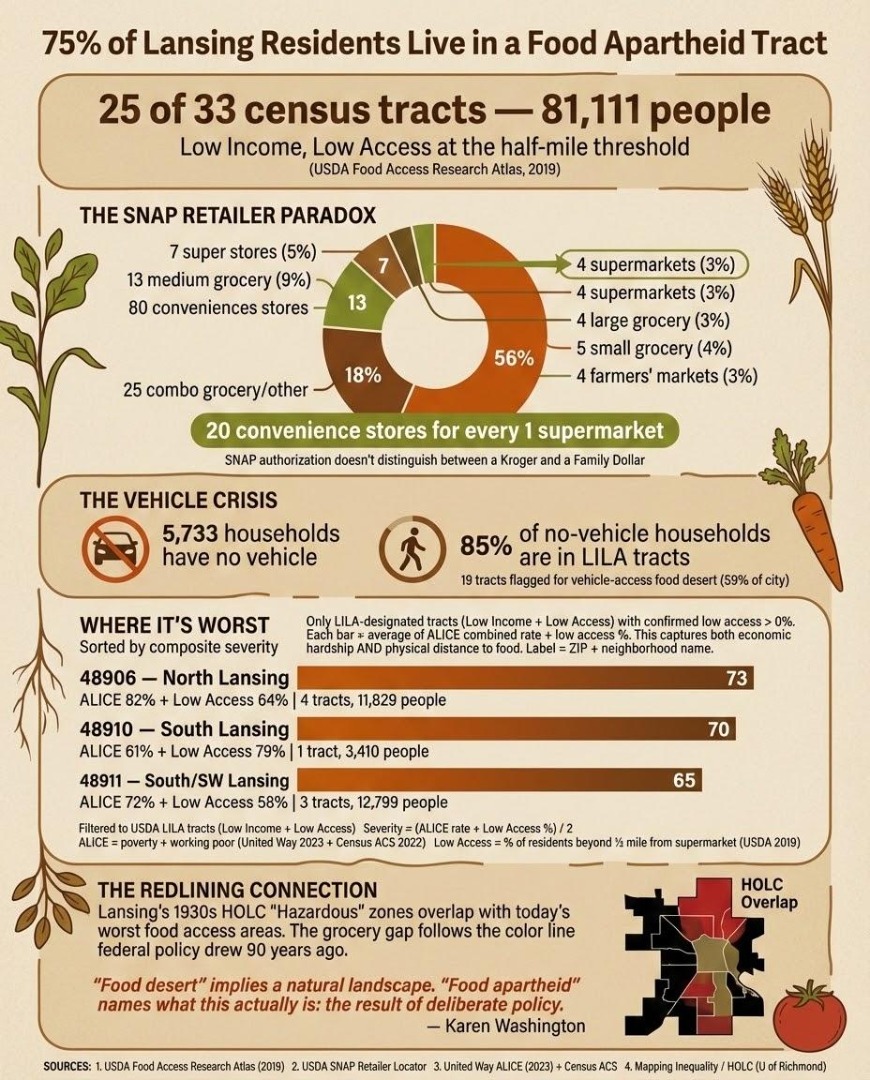
The Food Apartheid Problem
## Food Security in Lansing, MI ### The ALICE Lens ALICE — Asset Limited, Income Constrained, Employed — is a framework used to capture the households that earn above the Federal Poverty Level but still can't afford basic necessities. According to the 2025 United Way ALICE Report (using 2023 data), **50% of Lansing households fall below the ALICE threshold** — significantly higher than the regional average of 41% for the six-county United Way of South Central Michigan service area. That means one in two Lansing households is essentially one unexpected expense away from not being able to afford food. The 41% regional figure encompasses 171,521 households across Calhoun, Clinton, Eaton, Ingham, Jackson, and Kalamazoo counties — 14% in poverty and 27% who are barely making ends meet. Particularly vulnerable groups include single-female-led households with children (74% below ALICE threshold) and households headed by adults age 25 and under (72%). Michigan overall mirrors this pattern: 41% of state households are below the ALICE Threshold in 2023, with families forced to make impossible choices — whether to buy food or fill a prescription, or whether to pay utilities or cover a car repair. --- ### Scale of Food Insecurity in Mid-Michigan As of May 2024, nearly 100,000 neighbors in the Greater Lansing Food Bank's (GLFB) seven-county mid-Michigan service area — Clare, Clinton, Eaton, Ingham, Isabella, Gratiot, and Shiawassee counties — are experiencing food insecurity. This reflects a **22% increase** compared to the previous year, driven by persistent inflation and rising food costs. --- ### Food Access & Food Apartheids Lansing's geography and demographics create real barriers to food access. While the city is not as frequently cited as Detroit or Flint in statewide food apartheid analyses, it has significant access challenges: Lansing's own mayor (Andy Schor, formerly a state representative) championed legislation addressing the lack of easily accessible grocery stores in downtown areas, noting it as a "stumbling block" for communities even as they attract new residents. This points to a specific urban core access issue — people can live in a city surrounded by suburbs with stores, but still face a food apartheid locally. The USDA defines urban food apartheids (deserts) as low-income areas with no grocery store within one mile. Transportation is a compounding factor — lower-income Lansing residents are more likely to rely on public transit or have no vehicle, making even a 1.5-mile distance to a grocery store a significant barrier. --- ### Who's Most Affected The ALICE data paints a clear picture of which Lansing residents are most vulnerable to food insecurity: - **Working poor** — people employed in childcare, food service, home health aide, delivery, and retail jobs who earn above the poverty line but cannot cover basic living costs - **Seniors** — nearly half (49%) of age 65+ households in the region fall below the ALICE threshold; notably, GLFB recently announced it will no longer administer the Commodity Supplemental Food Program (CSFP) for seniors in Ingham and surrounding counties as of September 2025, adding additional strain on this population - **Single mothers** — nearly three-quarters of single-female-led households with children are below the ALICE threshold - **People with disabilities and those without transportation** — GLFB has specifically noted these populations are underserved by traditional food bank models --- ### Response Infrastructure The Greater Lansing Food Bank received a $790,000 MI Impact Grant from the state in 2023, specifically aimed at expanding a home delivery model to reach people who cannot access traditional food services — including those who are disabled, seniors who don't drive, and people in areas without reliable transportation. GLFB operates a network of more than 140 community partners across its seven-county region. Michigan has also taken broader action: the state budget has included $3 million for the Michigan Independent Retailers Association to aid grocers in addressing food apartheid, and programs like Double-Up Food Bucks stretch SNAP benefits at farmers markets and retail stores. Michigan also provides free school meals to all public school students, which helps address child food insecurity during the school year. --- ### Bottom Line Lansing faces a serious and worsening food security challenge. Half of its households can't comfortably afford life's basics, food insecurity in the region has spiked 22% in a single year, and access barriers — compounded by lack of transportation and gaps in downtown grocery retail — hit the city's most vulnerable residents hardest. The infrastructure of response (GLFB, pantries, state programs) is active and growing, but demand is clearly outpacing capacity.
**References** Here are all the sources behind the data points in my response: **United Way ALICE Report** - United Way of South Central Michigan ALICE Report (2025, using 2023 data) - https://www.unitedwayalice.org/michigan - https://www.uwscm.org/alice **Greater Lansing Food Bank (GLFB)** - https://www.greaterlansingfoodbank.org - GLFB 2024 data on 100,000 food insecure neighbors and 22% increase: reported in local news coverage, May 2024 **Michigan ALICE Statewide Data** - United Way for Southeastern Michigan / United Way Michigan ALICE portal: https://www.unitedwayalice.org/michigan **GLFB CSFP Senior Program Change** - Greater Lansing Food Bank announcement re: ending CSFP administration for seniors as of September 2025 — check directly at https://www.greaterlansingfoodbank.org for current program updates **MI Impact Grant ($790,000 to GLFB)** - Michigan Department of Labor and Economic Opportunity grant announcement, 2023 - Coverage available via https://www.michigan.gov and GLFB's own site **Michigan Food Desert & Independent Retailers funding ($3M)** - Michigan Independent Retailers Association: https://www.mira.org - Michigan state budget coverage — searchable via https://www.michigan.gov/budget **Double-Up Food Bucks** - https://www.doubleupfoodbucks.org **USDA Food Access Research Atlas (food desert mapping)** - https://www.ers.usda.gov/data-products/food-access-research-atlas/ **Feeding America Map the Meal Gap (county-level food insecurity data)** - https://map.feedingamerica.org - **greaterlansingfoodbank.org** — for current regional food insecurity stats - **unitedwayalice.org/michigan** — for the most current ALICE data by county and city - **feedingamerica.org** — for Ingham County food insecurity rates - **map.feedingamerica.org** — for county-level data including Ingham County